How to Start a Task When You Can’t (Even When You Really Want To)
When “just start” doesn’t work, you need a different way in. Here are seven.

Quick answer
To start a task when you can’t, stop trying to start the whole task. Pick the smallest physical action connected to it, like opening a file or picking up one dish, and promise yourself you can stop after that. Then reduce friction: get the tools ready, lower the standard, and add a person or a timer. Small, concrete moves get you started more reliably than motivation does.
Returning a package that’s been by the door for three weeks
- Pick up the package and put it on the kitchen table.
- Open the store’s order page on your phone. Just open it.
- Tap “Return” and read which return option is offered. Don’t choose yet.
- Pick the option with the closest drop-off point.
- Put the package, the tape and your keys together by the door.
Before confirming a return or refund, read the details on the store’s page. If anything about money is unclear, contact the store before you send it.
Why you can’t start, even when you want to
Wanting to do something and being able to start it are different things. Starting needs a clear first action, enough energy and a sense that it’s safe to begin. When one of those is missing, you stall, no matter how much you care.
That’s why “just do it” doesn’t help. It treats the problem as willpower when it’s usually about the shape of the task. Change the shape, and starting becomes possible.
1. Find the smallest physical first move
Most tasks are written as outcomes: “write the essay,” “clean the kitchen.” Outcomes can’t be started. Actions can. Ask yourself, “What would my hands do first?”
For an essay, it might be “open a new document and type the title.” For the kitchen, “put one glass in the sink.” If you want a full method, see how to break down a task.
2. Give yourself permission to stop
A lot of dread comes from the sense that once you start, you’re trapped until it’s done. Take that away. Agree to do one move, then you’re allowed to stop with no guilt.
Often you’ll keep going. Sometimes you won’t. Both are fine. One move done is better than none.
3. Remove friction before you begin
Every tiny obstacle adds weight. If you need to find a charger, log in somewhere and dig out a form before you can begin, you may never begin. Clear the path first.
- Put the tools where you’ll see them: the laptop open, the sponge by the sink.
- Write the login details or reference number on a sticky note ahead of time.
- Close extra tabs and put your phone in another room for ten minutes.
4. Lower the standard on purpose
If part of you believes the task has to be done well, starting feels risky. Give yourself a deliberately lower target: a messy first draft, one shelf instead of the whole closet, a rough outline instead of an essay.
You can improve it later. You can’t improve something that doesn’t exist yet. More on this in perfectionism and procrastination.
5. Borrow someone else’s presence
Many people find it much easier to start when someone else is around. That person doesn’t need to help. They just need to be there, on a video call, at the same table, or in a quiet online work room. This is often called body doubling.
6. Use a short timer, not a long one
A big block of time can feel like a wall. A small one feels like a step. Try these:
- Set a timer for five or ten minutes.
- Do only the first move, then the next one if you feel like it.
- When the timer rings, stop and decide fresh: another round, or a break.
If the deadline is close and panic is part of the problem, read how to start when the deadline is close.
7. Match the task to your energy
On low days, aim lower. Instead of “do the dishes,” it’s “rinse three plates.” Instead of “answer emails,” it’s “read the newest one.” Doing a gentler version of a task still counts and keeps you connected to it. See low energy days for more ideas.
If you can’t start things most days for a long time, it’s worth checking in with a doctor or qualified professional. Ongoing trouble starting can have many causes, and you deserve proper support.
How Snowball helps you start
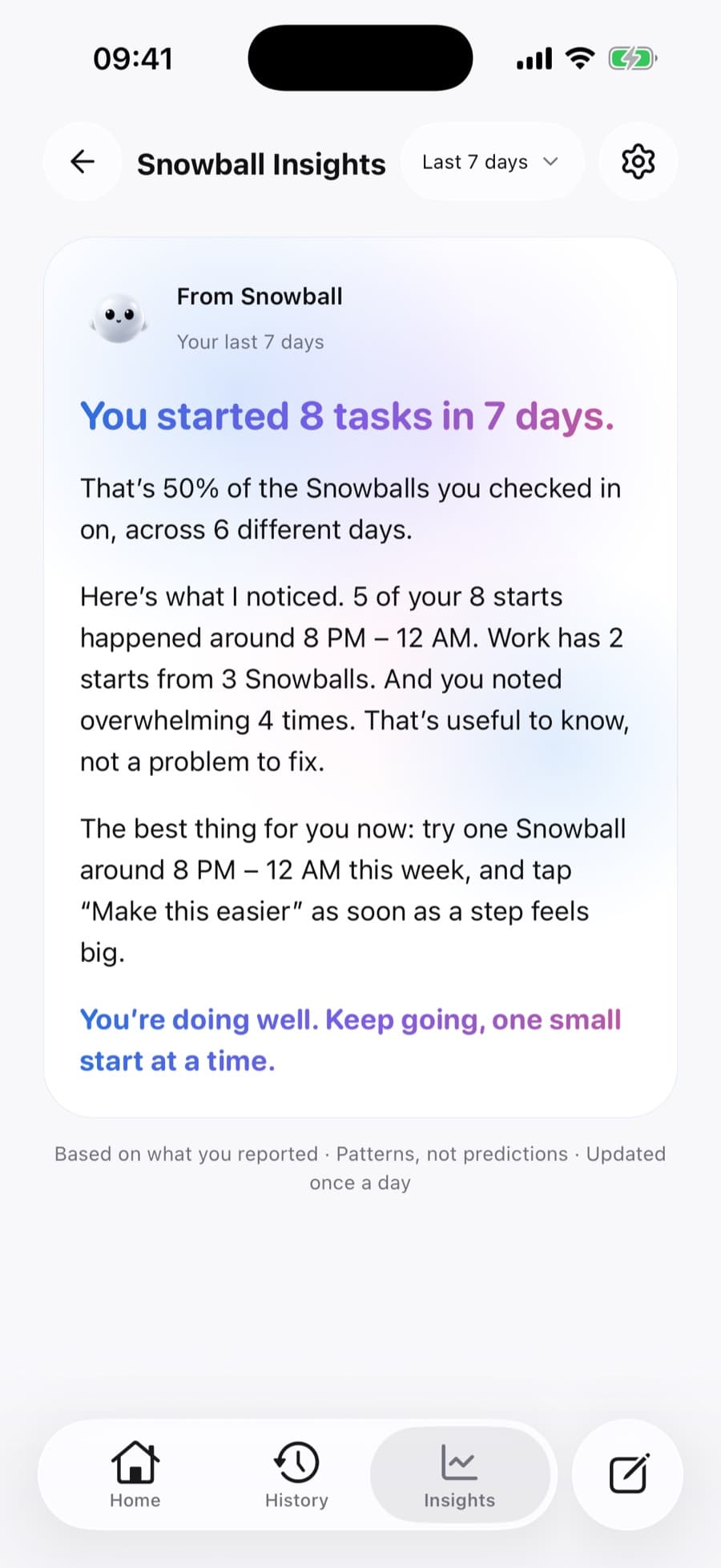
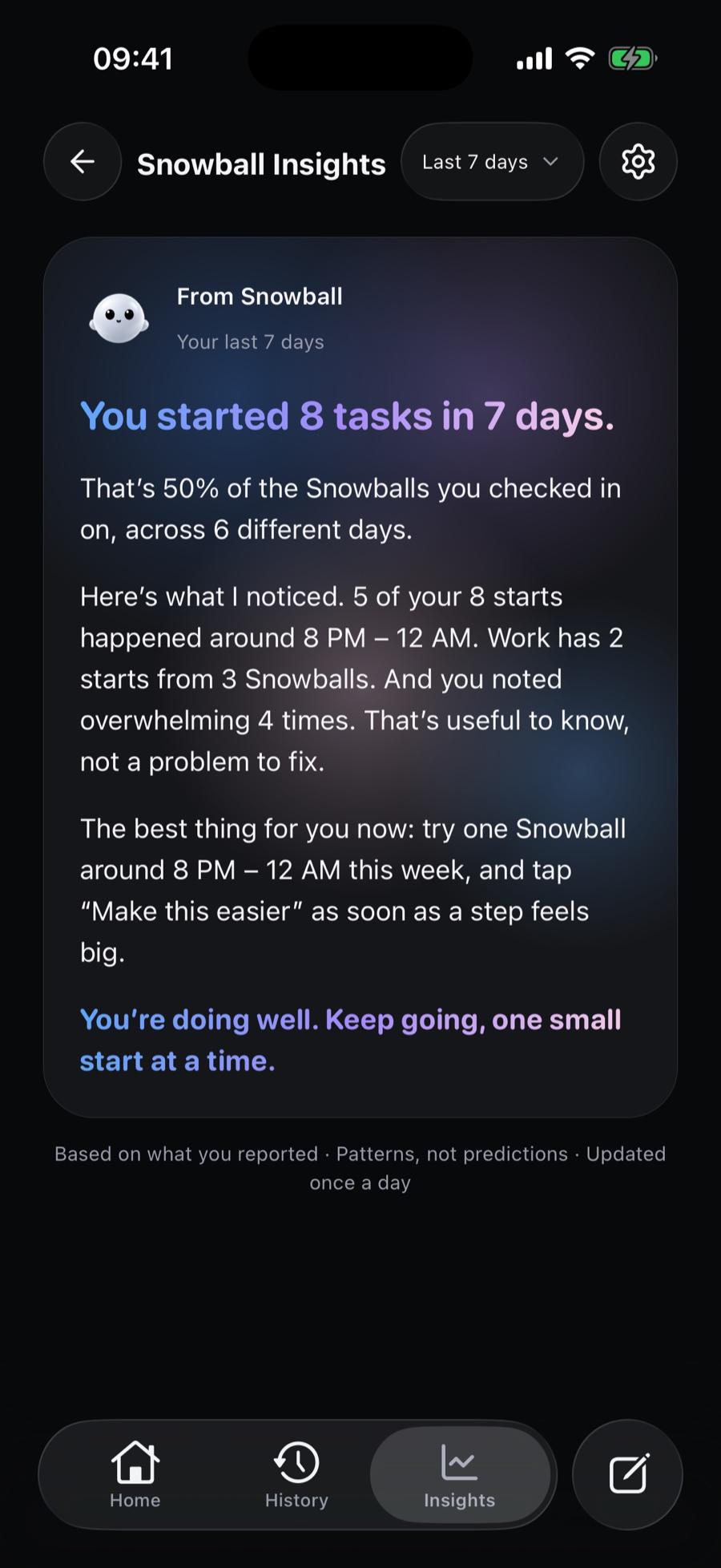
Snowball does the shrinking for you. Type what you can’t start, and it gives you a short, specific plan that ends with the task done, plus a tiny first move you can do right now. If a step still feels big, “Break it down” splits it into one- or two-minute moves.
You can skip a step, ask Snowball to change it, or stop for today, and it keeps your place. Suggestions can be wrong, so you stay in charge of what you actually send, submit or pay.
Questions people ask
Why can’t I start tasks even when I know they’re important?
Importance can add pressure instead of motivation. When a task matters, fear of getting it wrong grows, and the task can feel bigger. Starting also needs a clear first action and enough energy. If either is missing, knowing it’s important won’t be enough. Shrinking the first step usually helps more than reminding yourself why it matters.
How do I make myself do something I don’t want to do?
Instead of forcing it, make the start smaller and the conditions easier. Pick one tiny action, prepare the tools ahead of time, pair it with something pleasant like music, and set a short timer. Promise yourself a real stop point. Forcing usually backfires, while lowering the bar tends to get you moving.
Is not being able to start tasks a sign of something?
Trouble starting is very common and can come from stress, tiredness, low mood, anxiety, overload or ADHD, among other things. On its own it doesn’t point to any one cause. If it’s persistent and affects several parts of your life, a qualified professional can help you understand it.
What if I start and then stop again right away?
That still counts as progress. Note where you stopped, in a word or two, so coming back is easy. Next time, start from that exact spot with another tiny move. Many tasks get done in small bursts rather than one long session, and that’s a perfectly good way to work.
Sources and further reading (1)
- Centre for Clinical Interventions, procrastination resources — Practical strategies for getting started on tasks you’ve been putting off.