ADHD Cleaning: How to Clean With ADHD (and Keep It Clean)
Zones, visible systems and tiny resets that work with an ADHD brain, not against it.

Quick answer
To clean with ADHD, stop aiming for a whole clean house. Pick one small zone, clean it in a short timed round, and stop when the timer ends. Make your systems visible: open bins, hooks, a basket per room. Then protect what you did with a daily five-minute reset, and keep a gentler version for low-energy days.
A sequence to try: the kitchen counter, one zone only
- Stand at the counter next to the sink. Only that stretch counts as today’s zone.
- Set a timer for ten minutes and put your phone face down.
- Pick up every dish on the counter and put it in or beside the sink. Nothing else yet.
- Throw away anything that is clearly rubbish: wrappers, receipts, the empty jar.
- Wipe the clear part of the counter with one cloth, even if a few items are still there.
- When the timer rings, stop. Notice the clear patch. That is the win.
Swap the counter for any zone you can see from one spot: the bathroom sink, the desk surface, the floor beside your bed. Keep the zone small enough that ten minutes makes a visible difference.
Why cleaning is so hard with ADHD
Cleaning is a pile of tiny decisions with no clear end. Where does this go? Should I keep it? Which room first? For many people with ADHD, that endless choosing drains energy before any cleaning happens, which is why a messy room can feel impossible rather than just annoying.
It is also boring, repetitive and invisible once it is done. Nobody notices a clean floor, but everyone notices a dirty one. That mix of high effort and low reward is a big part of why people describe it as a wall. It is not laziness, and it is not a character flaw.
Struggling to clean doesn’t on its own mean you have ADHD. If ongoing difficulty with starting and finishing everyday tasks is affecting your life, a doctor or other qualified professional can help you understand what is going on.
How to clean with ADHD: think in zones, not rooms
“Clean the bedroom” is not a task. It is a project with twenty hidden tasks inside it. A zone is a patch you can see from one spot and finish in one short round: the nightstand, the top of the dresser, the floor between the bed and the door.
If you are standing in a room so messy you can’t pick a zone at all, start with the one-patch approach in how to start cleaning when you’re overwhelmed, then come back to zones once the first patch is clear.
- Write down three to five zones for the room you care about most.
- Pick the zone you would see first when you walk in.
- Give it one timed round of ten to fifteen minutes.
- Stop when the timer ends, even if you are on a roll. Stopping on time makes the next round easier to start.
- Tomorrow, do the next zone, or repeat the same one if it slid back.
Make your cleaning systems visible
Out of sight often means out of mind. Closed drawers and lidded boxes look tidy, but they turn into black holes where things vanish or never get put away. Systems you can see are easier to use on autopilot.
- Open bins and baskets instead of lidded boxes, one category per bin.
- Hooks by the door for keys, bags and the jacket you wear every day.
- A “landing basket” in each main room for things that belong somewhere else.
- Cleaning supplies stored where you clean: a spray and cloth under the bathroom sink, a second set in the kitchen.
- A laundry basket in the spot where clothes actually land, not where they should land.
If you keep putting something in the wrong place, the place is wrong. Move the home to where the item naturally ends up.
An ADHD cleaning routine you can keep: the five-minute reset
Deep cleans feel great, but maintenance is what keeps the house livable. A reset is a short, fixed round you do once a day, ideally tied to something you already do, like after dinner or before you brush your teeth.
Keep the list short and the same every day so you don’t have to decide anything. Five minutes is enough. If you do more, great, but five minutes counts as done.
- Dishes to the sink or dishwasher.
- Rubbish into the bin, bin bag out if it is full.
- Clothes from the floor into the laundry basket.
- Landing baskets emptied into the right rooms.
- One wipe of the kitchen counter.
Cleaning with a body double
Many people with ADHD find it easier to clean when someone else is around. This is called body doubling: another person’s presence, in the room or on a video call, makes it easier to start and keep going.
The other person doesn’t have to help. A friend can sit on the couch with a coffee while you fold laundry, or you can join a call where everyone cleans their own space for twenty minutes. Saying out loud what you will do first can make it easier to begin.
How to clean on low-energy days
Some days the full reset is too much, and that is fine. The goal on those days is to stop things getting worse, not to make them better. Choose the one task that would bother you most tomorrow and do only that.
Good low-energy options: put clean clothes on the bed so you have to move them, run the dishwasher even if it isn’t full, take out one bag of rubbish, or swap the kitchen towel. Sitting down while you sort is allowed. More ideas for days like this live in low-energy days.
Make cleaning less boring
Boredom is a real barrier, so give the task something to hold your attention. Pair cleaning with something you enjoy and save that thing only for cleaning, so it becomes a small reward.
- A podcast or audiobook you only play while cleaning.
- A playlist of exactly the length of your round, so the music tells you when to stop.
- A race: how many items can you put away before the kettle boils?
- Before and after photos of a zone, so you can actually see the difference.
How Snowball helps with ADHD cleaning
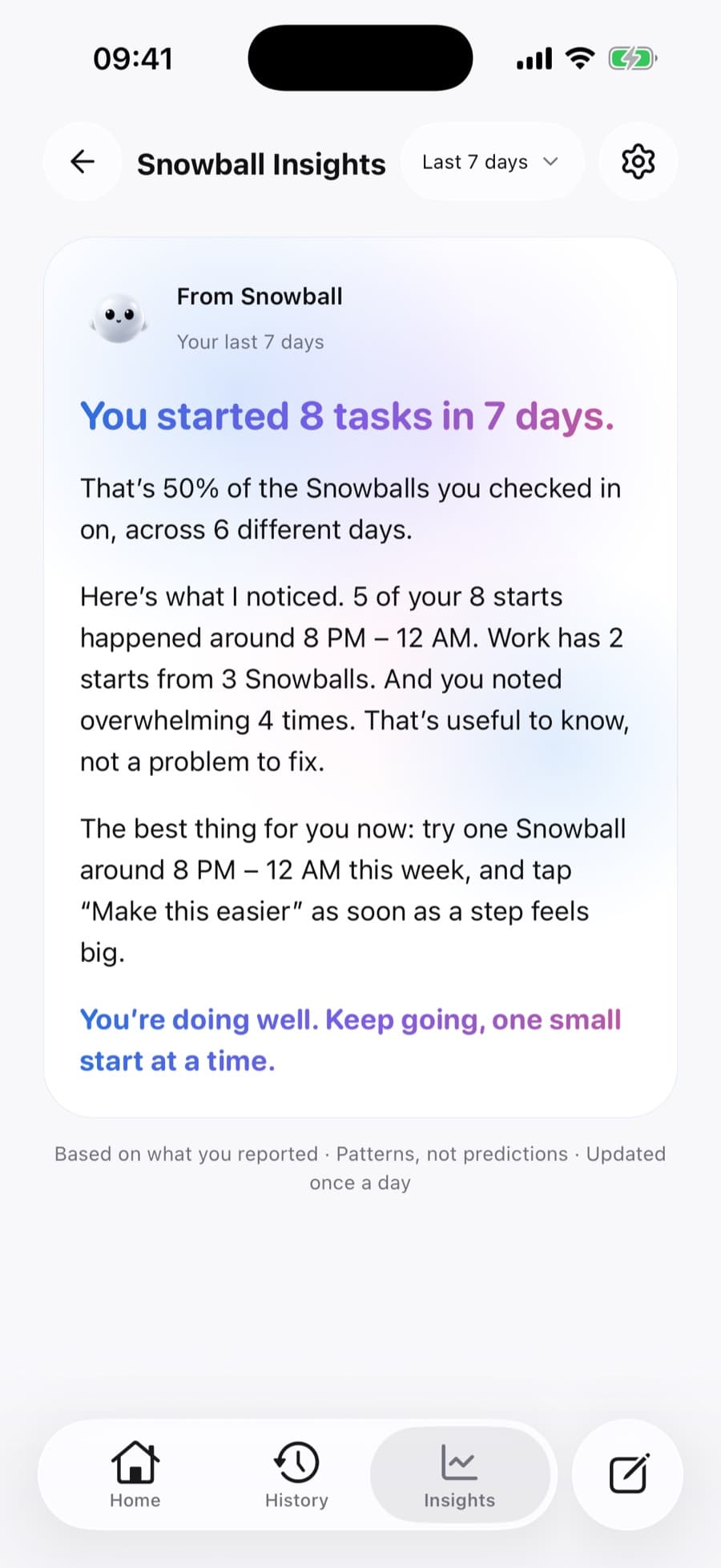
When you can’t pick where to start, you can type what you are stuck on, like “my kitchen is a disaster and guests come Saturday”, and Snowball turns it into a short plan that ends with the job done, with one tiny first move you can do right now. You do one step, come back, mark it done, and move on.
If a step still feels too big, “Break it down” splits it into moves of a minute or two. On hard days, Low Energy mode keeps the same plan but suggests gentler ways to start each step. You can stop for today and it keeps your place.
Questions people ask
Why can’t I clean my room with ADHD?
Cleaning a room asks for many small decisions, steady attention and patience with a boring task, which are often the hardest parts for people with ADHD. It helps to shrink the job to one small zone, use a timer, and decide in advance where things go. It is not laziness. If the difficulty is ongoing and affecting your life, a qualified professional can help.
What is the best cleaning routine for ADHD?
The best routine is the one short enough that you actually do it. A daily five-minute reset with the same few tasks, such as dishes, rubbish, clothes and one counter wipe, often works better than a long weekly clean. Tie it to something you already do every day, and keep a smaller version for tired days.
How do I keep my house clean with ADHD?
Focus on maintenance rather than big cleans. Give every common item a visible home near where you use it, keep landing baskets in each room for things that belong elsewhere, and do a short daily reset. When the house slides, restart with one zone instead of trying to fix everything in one day.
Does body doubling help with cleaning?
For many people, yes. Having someone nearby, in person or on a video call, can make it easier to start cleaning and keep going. The other person doesn’t need to help or even talk. Try a set time, such as twenty minutes, and tell them the first thing you will do before you start.
Is it OK to only clean a little each day?
Yes. Small daily rounds usually keep a home in better shape than rare marathon cleans, which can leave you exhausted and avoiding the next one. Ten minutes on one zone, or a five-minute reset, is real progress. Stopping on time also makes it easier to start again tomorrow.
Sources and further reading (1)
- NHS, “Attention deficit hyperactivity disorder (ADHD)” — General background on ADHD symptoms in adults, such as difficulty with organization and finishing tasks, and on getting an assessment.