Time Blindness and ADHD: Why You Start Late and How to Start on Time
When time feels invisible, deadlines sneak up. The fix is making time something you can see and planning when to start, not only when to finish.

Quick answer
Time blindness is a common way people with ADHD describe losing track of time: “later” feels far away until it suddenly isn’t, and tasks take longer than expected. It helps to make time visible with a clock you can see, set a start time instead of only a deadline, and add a buffer so a late start doesn’t become a crisis.
Getting out the door for a 10:00 appointment
- Right now, write “Leave at 9:25” on a sticky note and put it on your phone case.
- Set one alarm for 9:10 labeled “Shoes and keys”, not “Appointment”.
- Put a clock where you’ll actually see it while you get ready, like the bathroom shelf.
- At 9:10, put on your shoes before you do anything else, even if you feel early.
- Put your keys, wallet and the appointment letter in one spot by the door.
- Walk out at 9:25. If you arrive early, the waiting time is your buffer, not a mistake.
Swap in any fixed-time event: a video call, a train, school pickup. The trick is the same: work backward to a leave or start time, then put that time somewhere you can see.
What is time blindness?
Time blindness isn’t a formal diagnosis. It’s a popular phrase many people with ADHD use for a real experience: time doesn’t feel like something you can sense. There’s “now” and there’s “not now”, and everything in “not now” feels roughly the same distance away.
That’s why a deadline next Friday and a deadline in three hours can feel equally unreal, right up until the moment one of them becomes urgent. It’s not carelessness. It’s that the clock isn’t sending you clear signals.
What does time blindness look like in everyday life?
It often shows up as a pattern you recognize but can’t seem to change. You mean well, you plan to start, and somehow the window closes.
- You think a task will take 10 minutes and it takes 45.
- You check the time, look away “for a second”, and an hour is gone.
- You leave for appointments at the time you should already be there.
- You wait all morning for a 2 p.m. call and get nothing else done.
- Big projects feel like they have endless time until the night before.
Why time blindness makes starting so hard
Most of us are taught to plan around deadlines. But a deadline only tells you when something must be finished. If you can’t feel how long the work takes, the deadline gives you no useful signal about when to begin, so you start when panic arrives instead.
There’s also the waiting problem. When something is scheduled later, it can freeze the whole day because part of your mind is watching the clock. If that sounds familiar, read about waiting mode, which is closely related.
Starting late now and then doesn’t on its own mean you have ADHD. If time problems keep causing real trouble at work, school or home, a qualified professional can help you understand what’s going on.
How to make time visible
If you can’t feel time passing, make it something you can see. The goal is to bring the clock into your line of sight so you don’t have to remember to check it.
- Use an analog clock or a visual timer where you work, so you see time shrinking, not just a number.
- Name your alarms after the action, like “Start the report” or “Shoes on”, not just a time.
- Put a clock in the rooms where time disappears: bathroom, kitchen, next to the couch.
- Set a timer for scrolling or “quick” checks so “one minute” has an actual end.
Plan start times, not just deadlines
Every deadline needs a partner: a start time. For a report due Thursday at 5, the useful question isn’t “When is it due?” but “When do I sit down and open the document?” Put that start time in your calendar like a meeting.
Keep the start tiny so it’s easy to keep. The calendar entry can say “Open the report file and write the title”, not “Write the report”. Once you’ve started, it’s much easier to keep going. For more on that first move, see task initiation.
- Write down the deadline.
- Guess how long the task takes, then double it.
- Count backward from the deadline to find your start time.
- Put the start time in your calendar with a tiny first action as the title.
- Set an alarm 10 minutes before so you can wrap up what you’re doing.
How to estimate time when your guesses are always off
Your gut estimate is a starting point, not a fact. For a while, time yourself on ordinary tasks: emptying the dishwasher, answering one email, getting dressed. Write the real number down. You’ll quickly see which tasks you underestimate, and by how much.
Until you have your own numbers, use a simple rule: double your guess for anything you haven’t done recently, and add the in-between bits people forget, like finding your keys, loading the website or getting a parking space.
Why buffers save you
A buffer is extra time you plan on purpose. It turns a late start from a disaster into a small delay. Aim to leave 15 minutes early, or to finish a work task the afternoon before it’s due, not the minute it’s due.
Buffers also protect anything that needs care, like a form or a payment. Rushing at the last minute is when mistakes happen, so give yourself room to review before you submit or pay. If you’re already up against it, here’s how to start when the deadline is close.
If you arrive early, bring something small to do while you wait. Then the buffer never feels wasted.
How Snowball helps with time blindness and starting
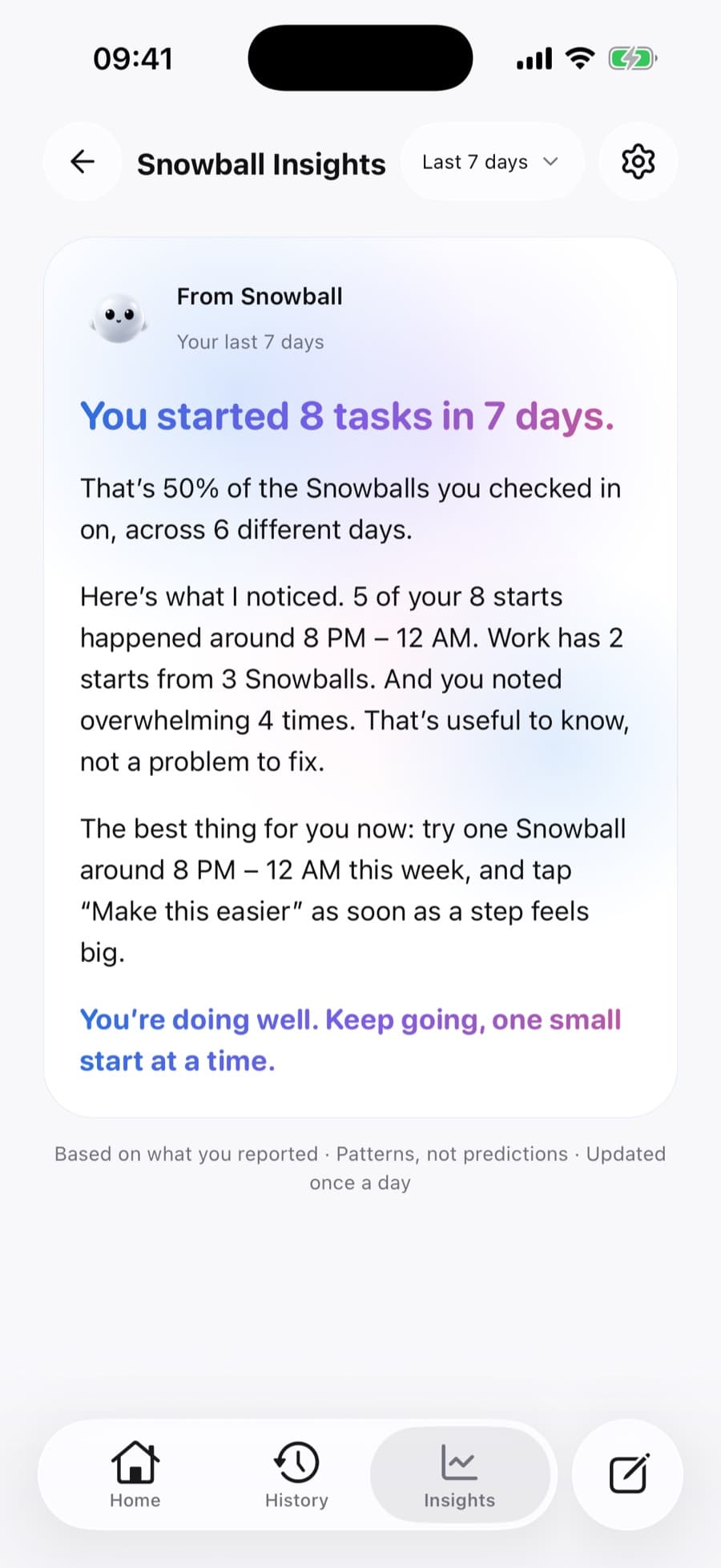
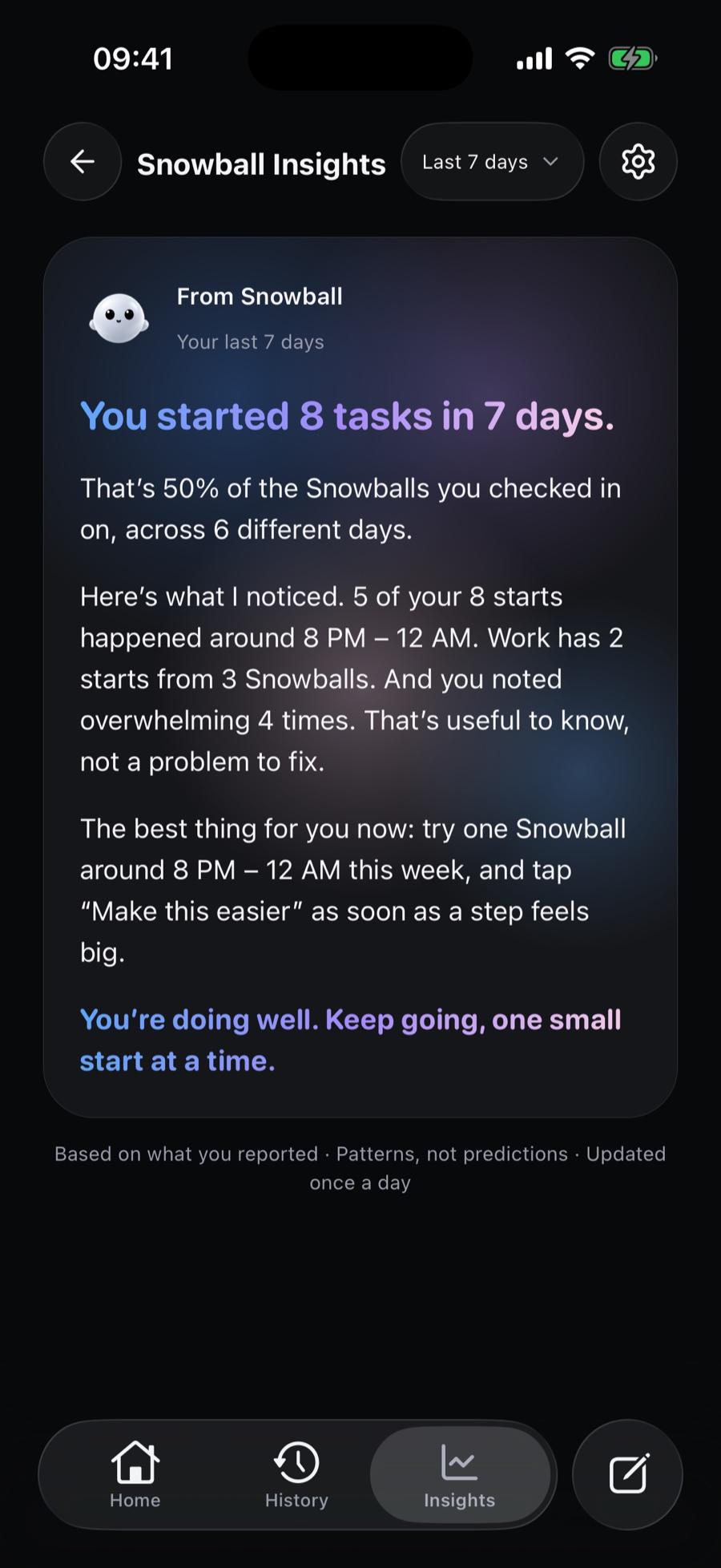
Snowball doesn’t track the clock for you, but it makes the start much smaller. You type what you’re stuck on, like “I need to leave for the dentist and I’m still in bed”, and it gives you a short plan and one tiny first move you can do right now.
If you tell Snowball “About you”, such as your schedule or how you like to work, plans can fit your day better. It stays on your iPhone. And on days when even small steps feel heavy, Low Energy mode offers gentler ways to begin.
Questions people ask
Is time blindness a real ADHD symptom?
“Time blindness” is an informal term rather than a diagnostic one, but many people with ADHD use it to describe real difficulties with sensing time, estimating how long things take and planning ahead. If time problems affect your life a lot, a qualified professional can assess what’s behind them.
Why do I always underestimate how long things take?
Many people remember the core of a task and forget the setup and in-between parts: finding things, loading pages, getting interrupted. Time yourself on a few everyday tasks and compare with your guesses. Until you know your own pattern, doubling your estimate is a simple, forgiving rule.
What is the best clock for time blindness?
Many people find an analog clock or a visual timer easier than digital numbers because you can see time as a shrinking space. The best one is the one you can see from where you work. A cheap clock on the bathroom shelf can help more than an app you never open.
How do I stop being late all the time?
Plan a leave time instead of an arrival time, then set an alarm a few minutes before it labeled with the action, like “Shoes on”. Get your bag and keys ready in one spot by the door. Add a 15-minute buffer so a small delay doesn’t make you late.
Can I fix time blindness?
You may not be able to change how time feels, but you can build supports around it: visible clocks, start times in your calendar, action-named alarms and buffers. These lean on your environment instead of memory, which tends to be more reliable on busy or tired days.
Sources and further reading (1)
- NHS, “Attention deficit hyperactivity disorder (ADHD)” — General overview of ADHD in adults, including difficulties with organization and time management, and how to seek an assessment.