Procrastination vs ADHD: Is It Procrastination or Something More?
They can look the same from the outside. Here’s how the patterns tend to differ, and what helps in both cases.

Quick answer
Procrastination is putting off a task, something almost everyone does. ADHD is a condition that affects attention, activity and organization across many areas of life, often since childhood. Procrastination can be part of ADHD, but delaying tasks doesn’t on its own mean you have ADHD. Only a qualified professional can assess that. The practical tools that help you start work in both cases.
A work report you’ve put off, whatever the reason
- Open last month’s report and save a copy with this month’s date.
- Delete the old numbers but keep the headings.
- Under the first heading, type one rough sentence about this month.
- Paste in one number you already know, even if the rest are blank.
- Write a note at the top saying which section you’ll fill next.
This works whether you’re procrastinating, have ADHD, or both. Reusing an old structure takes the blank-page decision away.
What is procrastination?
Procrastination means delaying something you intend to do, even though you expect the delay to make things worse. It’s extremely common. Almost everyone has put off a phone call, a tax form or a dentist booking at some point.
It usually has an emotional side. You avoid the task because it feels boring, stressful, uncertain or tied to a fear of doing it badly. Putting it off brings short-term relief, which makes it easy to repeat.
What is ADHD?
ADHD (attention-deficit/hyperactivity disorder) is a condition that affects attention, activity level and impulse control. In adults it often shows up as trouble with organization, time, focus, finishing tasks and remembering things. Symptoms usually start in childhood and show up in more than one setting, like work and home.
ADHD is diagnosed by qualified professionals through a proper assessment. An online quiz or an article like this one can’t tell you if you have it.
Is it procrastination or ADHD? How the patterns tend to differ
There’s a lot of overlap, so these are tendencies, not tests. They can help you describe your experience to a professional.
- Scope: procrastination often focuses on specific dreaded tasks. With ADHD, difficulties tend to show up across many areas: work, home, money, relationships.
- History: with ADHD, people often recognize similar struggles going back to childhood. Procrastination may come and go with stress or particular tasks.
- Type of task: procrastination is usually about unpleasant tasks. With ADHD, even things you want to do, like a hobby or a friend’s birthday gift, can be hard to start or finish.
- Other signs: ADHD typically involves more than delay, such as losing things, losing track of time, restlessness or getting easily distracted mid-task.
- What helps: for occasional procrastination, a plan and some self-compassion often go a long way. With ADHD, people often need ongoing outside structure.
Why the two get mixed up
From the outside, both look like a task not getting done. And they can exist together: many people with ADHD procrastinate, and procrastination can come from anxiety, depression, burnout or perfectionism too. That’s why behavior alone can’t tell you the cause.
Social media also blurs the line. Relatable posts can help you feel less alone, but they can’t assess you. If something resonates strongly, treat it as a reason to learn more, not a conclusion.
Questions to notice about your own pattern
Instead of trying to label yourself, try noticing. Jot down answers over a week or two. They’re useful whether or not you seek an assessment.
- Which tasks do I put off? Only dreaded ones, or also ones I enjoy?
- Is this new, or have I struggled like this for as long as I can remember?
- Does it happen in one area, or at work, home and with money too?
- What else is going on: stress, sleep, mood, a big life change?
- What has helped before, even a little?
When to talk to a professional
Consider talking to a doctor or another qualified professional if difficulty starting or finishing things is long-standing, shows up across several parts of your life, or is causing real problems like missed bills, work trouble or strain in relationships. It’s also worth reaching out if you feel persistently low or anxious.
Bring your notes from the questions above. Concrete examples, like “I’ve had unopened mail for three months,” are more useful than general impressions. If unopened mail is part of the picture, you’re not alone.
What helps you start, whatever the cause
You don’t need a label to try practical tools. These help with procrastination and with ADHD-related trouble starting:
- Break the task into small physical steps. See how to break down a task.
- Start for a short, fixed time instead of aiming to finish.
- Reuse old structures, like last year’s email or report, to skip the blank page.
- Work alongside someone else, in person or online.
- Notice and loosen perfectionism: aim for a rough first version.
For tips focused on the habit itself, read how to stop procrastinating and start.
How Snowball helps, with or without ADHD
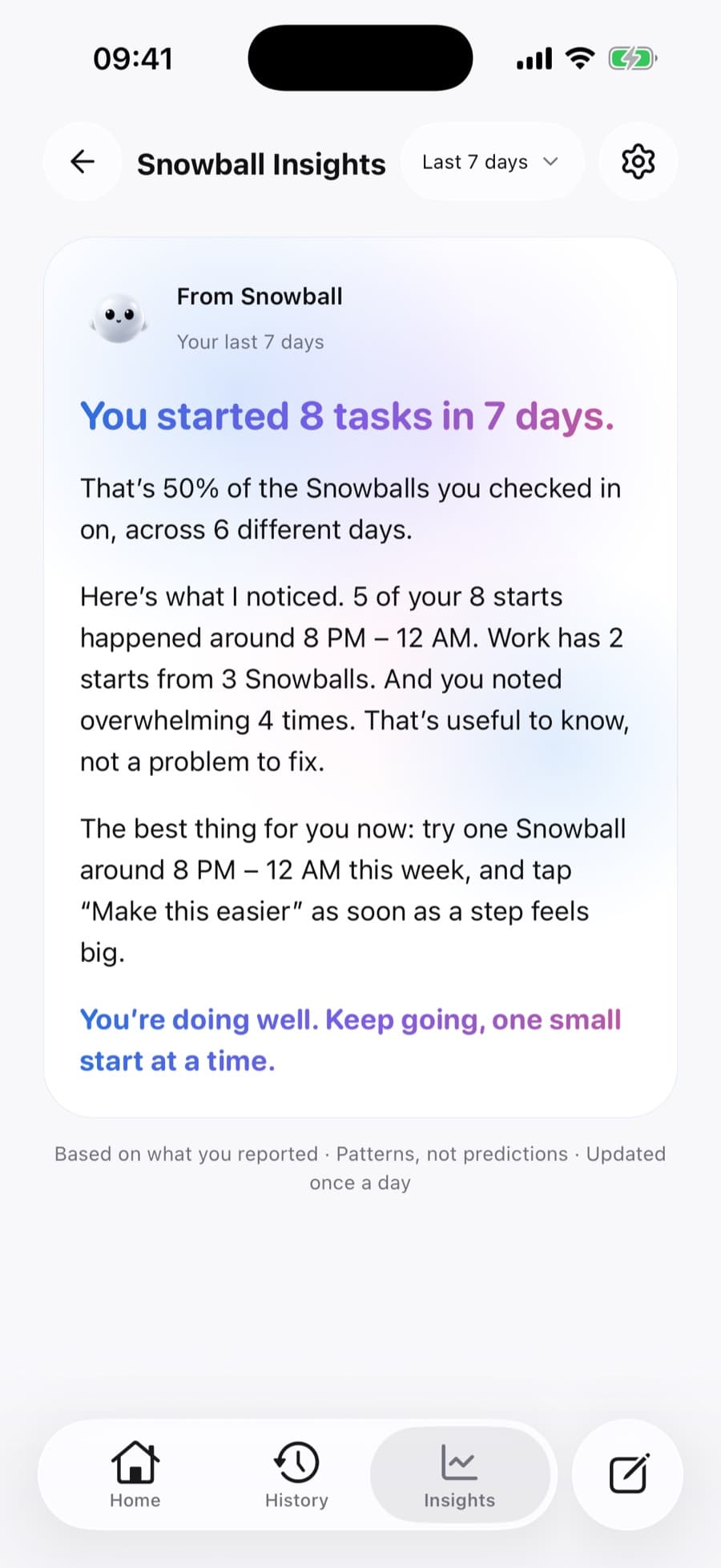
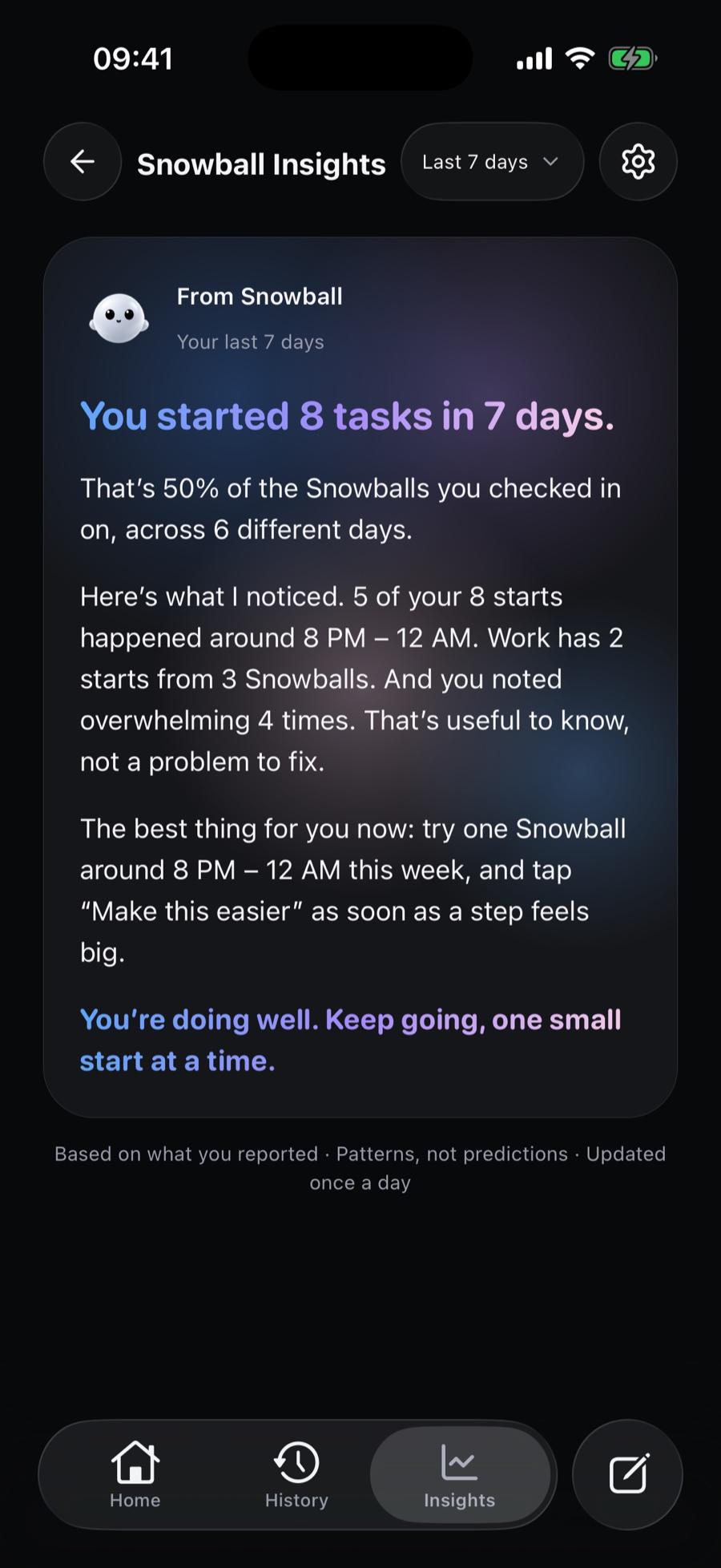
Snowball doesn’t care why you’re stuck, and it doesn’t try to diagnose anything. You type the task, and it gives you a short plan that ends with it done, plus one tiny first move. Over time, Insights can show patterns in when and how you start, which can be useful to reflect on yourself or share in a conversation with a professional.
It’s a productivity tool, not a medical service or a substitute for an assessment.
Questions people ask
Can you have ADHD and also just procrastinate?
Yes. People with ADHD procrastinate for the same reasons anyone does, like boredom or fear of failure, and ADHD can make starting harder on top of that. The two often show up together, which is one reason a professional assessment looks at your whole history rather than one behavior.
Is chronic procrastination a sign of ADHD?
Not by itself. Chronic procrastination can be linked to many things, including anxiety, low mood, perfectionism, burnout and ADHD. If it’s long-standing and comes with other difficulties like losing track of time or things, it may be worth discussing with a qualified professional.
How do I get assessed for ADHD as an adult?
A good first step is usually your primary care doctor or a mental health professional. They can talk through your history and, if appropriate, refer you for a full assessment. The process differs by country and health system, so check how it works where you live.
Do the same strategies work for procrastination and ADHD?
Many do. Breaking tasks down, short timed starts, working alongside others and reducing friction help in both cases. People with ADHD may need these supports more often and more consistently, and may benefit from additional professional support depending on their situation.
Can an online quiz tell me if I have ADHD?
No. A quiz may help you notice patterns or decide to seek help, but it can’t diagnose ADHD. Many conditions and life situations can produce similar experiences. A qualified professional uses a fuller assessment, including your history and how symptoms affect your daily life.
Sources and further reading (3)
- NHS, “Attention deficit hyperactivity disorder (ADHD)” — Describes ADHD symptoms in adults and how to seek an assessment.
- NIMH, “Attention-Deficit/Hyperactivity Disorder in Adults: What You Need to Know” — Explains how ADHD is diagnosed and that symptoms begin in childhood.
- Centre for Clinical Interventions, procrastination resources — Background on what procrastination is and why people do it.